


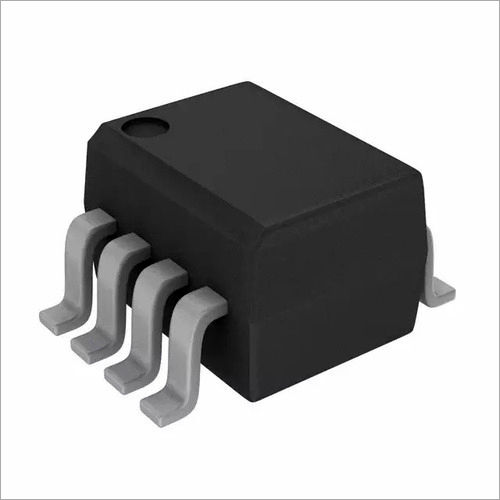
ACPL227 Integrated Circuits
20 INR
Product Details:
- Product Type Integrated Circuit (IC) - Dual Channel Optocoupler
- Application Switching Power Supplies, Signal Isolation, Data Communication
- Supply Voltage 5V to 20V
- Dissipation Power 250 mW
- Operating Temperature -40C to +100C
- Power Consumption Low Power Consumption
- Temperature Range -40C to +100C
- Click to View more
X
ACPL227 Integrated Circuits Price And Quantity
- 10 Piece
- 20 INR
- Yes, RoHS Compliant
- Transistor Output
- 2500 Vrms (minimum)
- 50% ~ 600%
- 3 µs (Typical)
- Tin (Sn) Plated
- Surface Mount (SMD), SO-8
- Dual-channel optocoupler
- 10 mA (typical per input channel)
ACPL227 Integrated Circuits Product Specifications
- 1.2V (typical LED Input Forward Voltage)
- Low Power Consumption
- 250 mW
- 6-pin DIP (Approx. 7.0 x 6.0 x 3.2 mm)
- 5V to 20V
- -40C to +100C
- Switching Power Supplies, Signal Isolation, Data Communication
- -40C to +100C
- Integrated Circuit (IC) - Dual Channel Optocoupler
- ~1g
- Yes, RoHS Compliant
- Transistor Output
- 2500 Vrms (minimum)
- 50% ~ 600%
- 3 µs (Typical)
- Tin (Sn) Plated
- Surface Mount (SMD), SO-8
- Dual-channel optocoupler
- 10 mA (typical per input channel)
ACPL227 Integrated Circuits Trade Information
- Cash Against Delivery (CAD), Cash in Advance (CID)
- 3000 Piece Per Day
- 2-3 Days
- Yes
- Within a certain price range free samples are available
- All India
Product Description
227ACPL Integrated Circuits are type of half-pitch transistor optocouplers that comprise optically coupled LEDs. They are completely suitable to be used for programmable controllers, measuring instruments, computers, and sequence controllers. These ICs offered by us are RoHS compliant in nature hence are free from Pb. They assure optimum current transfer ratio with complete reliability. 227ACPL Integrated Circuits offered by us are of superior quality and assures long service life.
Features:
- Hassle-free installation
- Error-free performance
- Superior quality
Technical Specification
|
Absolute Max |
50 (mA) |
|
Package |
SO8 |
|
Vf max |
1.3 (V) |
|
VCE SAT Max |
0.4 (V) |
|
UL Insulation Rating Viso |
3000.0 (VRMS) |
|
Lifecycle |
Active |
|
Distrib Inventory |
Yes |
|
CTR Min |
50.0 (%) |
|
CTR Max |
600 (%) |
|
BVCEO |
80 (V) |
Dual-Channel Optocoupler for Enhanced Isolation
The ACPL227 provides two independent optically-isolated channels in a compact SO-8 package, facilitating superior isolation between input and output. Its design helps safeguard sensitive electronics from voltage spikes and electrical noise commonly encountered in industrial environments.
Fast, Reliable Switching for Power Supplies and Communication
With a fast 3 s response time and a broad current transfer ratio, the ACPL227 enables efficient, dependable signal processing in switching power supplies and data communication systems. Its low input current and modest power consumption optimize it for energy-sensitive applications.
Wide Temperature and Voltage Range with RoHS Compliance
Capable of operating from -40C to +100C and supporting supply voltages from 5V to 20V, the ACPL227 adapts well to harsh environments. RoHS compliance guarantees its use in environmentally responsible designs for global markets.
FAQs of ACPL227 Integrated Circuits:
Q: How does the ACPL227 optocoupler enhance isolation in electronic circuits?
A: The ACPL227 uses optical isolation to separate input and output signals, effectively protecting sensitive components from high voltage transients and electrical noise. Its dual channels allow for the isolation of two independent signals within a single compact package.Q: What applications are best suited for the ACPL227 optocoupler?
A: This device is ideal for switching power supplies, signal isolation, and data communication systems where electrical isolation and low power consumption are crucial. Its wide temperature range and robust construction make it suitable for industrial and commercial environments.Q: When is it beneficial to use a dual-channel optocoupler like the ACPL227?
A: Dual-channel optocouplers are advantageous when isolating two independent signals simultaneously is required, such as in multi-channel switching circuits or redundant safety systems. This reduces board space and simplifies layout while maintaining strong isolation.Q: Where can I purchase the ACPL227 optocoupler in India?
A: The ACPL227 is available through authorized distributors, importers, manufacturers, suppliers, and wholesalers across India. You can source it from specialized electronic component retailers or online platforms that cater to industrial and commercial sectors.Q: What is the standard process for integrating the ACPL227 in SMD circuit designs?
A: To integrate this SO-8 surface-mount device, solder the tin-plated leads onto the PCB using standard SMD reflow techniques, ensuring rated voltage isolation is maintained in circuit layout. Follow typical guidelines for decoupling and thermal management within the specified operating temperature range.Q: How does the current transfer ratio (CTR) range benefit circuit designers?
A: A broad CTR range (50% to 600%) allows for flexible design, accommodating various input drive conditions while ensuring reliable transistor output. This enhances adaptability for signal conditioning applications and tailors the device to precise interface requirements.Q: What advantages does RoHS compliance provide for the ACPL227?
A: RoHS compliance means the ACPL227 is free from certain hazardous substances, making it safe for use in environmentally regulated markets. This compliance facilitates global distribution, promotes workplace safety, and supports green electronics initiatives.Tell us about your requirement

Price:
Quantity
Select Unit
- 50
- 100
- 200
- 250
- 500
- 1000+
Additional detail
Mobile number
Email

Other Products in 'SMD ICS' category



Contact Details
KK INTERNATIONAL
Mumbai, Maharashtra, India
Mumbai, Maharashtra, India

- Plot No. 305, Rajdeep Apartments, Tara Temple Lane, Near Lamington Road,Mumbai - 400007, Maharashtra, India
- Phone : 08045477473
- Mr Pratik Chouhan (Managing Director)
- Mobile : 08045477473
-
 Send Inquiry
 Send Inquiry
 Send Inquiry
 Send SMS
Quick Inquiry

 |
KK INTERNATIONAL
All Rights Reserved.(Terms of Use) Developed and Managed by Infocom Network Private Limited. |
