


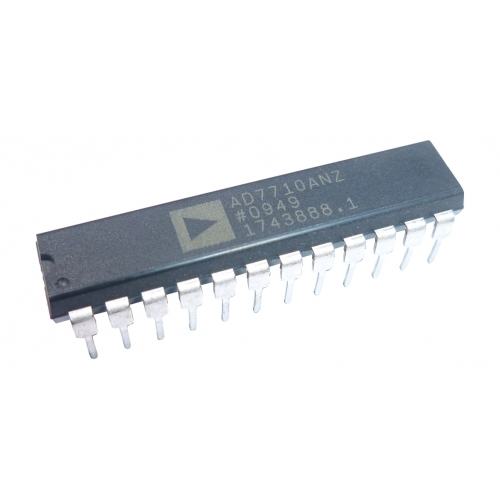
AD7710AN
900 INR
Product Details:
- Features Low Power, Programmable Gain, On-Chip Calibration
- Output Digital Data (Serial Output)
- Resolution 24 Bit
- Power Source DC Powered
- Power Supply External DC Supply
- Response Time Serial Output Data Rate ~10Hz to 1kHz
- Usage Precision Measurement Applications
- Click to View more
X
AD7710AN Price And Quantity
- 900 INR
- 10 Piece
- 2.5V
- 1 ppm typical
- External reference required
- 10 Hz to 1 kHz programmable
- 10 M (typical)
- 5 ppm typical
- 2 Differential or 4 Single-Ended
- DIP-20
- 2000V (HBM)
- Yes
- Through Hole
- Twos Complement, Serial
AD7710AN Product Specifications
- Integrated Circuit (IC)
- Data Acquisition Systems, Instrumentation
- 31.9mm x 18.5mm x 4.83mm
- 24-Bit Sigma-Delta Analog-to-Digital Converter
- 5 V
- Digital Data (Serial Output)
- 24 Bit
- Master Clock Up to 10 MHz
- Standard DIP-24
- Black
- Approx. 5g
- Low Power, Programmable Gain, On-Chip Calibration
- Typical 800A
- Single Channel
- Analog Voltage Signal
- External DC Supply
- SPI-Compatible Serial Interface
- Precision Measurement Applications
- Serial Output Data Rate ~10Hz to 1kHz
- DC Powered
- +5 V DC
- Monolithic CMOS IC
- Standard IC Package
- -40C to +85C
- 2.5V
- 1 ppm typical
- External reference required
- 10 Hz to 1 kHz programmable
- 10 M (typical)
- 5 ppm typical
- 2 Differential or 4 Single-Ended
- DIP-20
- 2000V (HBM)
- Yes
- Through Hole
- Twos Complement, Serial
AD7710AN Trade Information
- All India
Product Description
AD7710AN
Specification
| Architecture | Sigma-Delta |
| Features | PGA |
| Voltage Supply Digital | 5V |
| Voltage Supply Analog | 5 V ~ 10 V |
| Supplier Device Package | 24-PDIP |
| Sampling Rate | 1k (Per Second) |
| Reference Type | External, Internal |
| Part Status | Obsolete |
| Packaging | Tube |
| Package Case | 24-DIP (0.300", 7.62mm) |
| Operating Temperature | -40 deg C ~ 85 deg C |
| Number of Inputs | 2 |
| Number of AD Converters | 1 |
| Input Type | Differential |
| Data Interface | SPI |
| Configuration | MUX-PGA-ADC |
| Base Part Number | AD7710 |
High-Resolution Precision
Benefit from a true 24-bit resolution and extremely low linearity and gain errors. The AD7710AN ensures reliable measurements, making it a solid choice for precision instrumentation and data acquisition applications. Its robust performance under various environmental conditions highlights its suitability for demanding sectors such as industrial control and laboratory research.
Flexible Integration and Configuration
The AD7710AN offers versatile input handling, supporting two differential or four single-ended channels. An external reference voltage ensures adaptability for different system requirements. Featuring a serial output interface (SPI-compatible) and programmable sampling rates from 10 Hz to 1 kHz, this converter simplifies integration into new and existing designs.
FAQs of AD7710AN:
Q: How do I connect the AD7710AN to my data acquisition system?
A: The AD7710AN can be easily integrated using its 20-pin DIP package for through-hole mounting. It communicates via a SPI-compatible serial interface, allowing straightforward connection with most microcontrollers or processors used in data acquisition systems.Q: What input voltage range does the AD7710AN support?
A: It accepts analog input signals within a 2.5V range and features a high typical input impedance of 10 M. This wide and precise range is suitable for sensitive measurement tasks in instrumentation and laboratory equipment.Q: When should I use differential versus single-ended inputs?
A: Differential inputs are recommended for improved noise immunity and common-mode noise rejection, ideal for environments with significant electrical interference. Single-ended inputs are suitable when noise is less of a concern or when more channels are needed (up to four).Q: Where should I source the external reference voltage for optimal performance?
A: Use a stable, low-noise voltage reference, either from a high-precision dedicated reference IC or a temperature-stable source. The external reference ensures the ADC maintains high accuracy across varying conditions.Q: What is the main use or benefit of the AD7710ANs on-chip calibration feature?
A: On-chip calibration enables automatic compensation for offset and gain errors, maximizing measurement accuracy over the operational temperature range. This minimizes the need for user intervention and ensures consistent results.Q: How does the programmable sampling rate benefit my application?
A: You can select sampling rates between 10 Hz and 1 kHz to optimize for either higher resolution/accuracy (at lower rates) or faster data throughput (at higher rates), adapting to the specific performance requirements of your system.Q: Is the AD7710AN compliant with RoHS and does it feature ESD protection?
A: Yes, the AD7710AN is RoHS compliant, ensuring it meets environmental and safety standards. It also includes ESD protection up to 2000V (HBM), safeguarding it during handling and assembly.Tell us about your requirement

Price:
Quantity
Select Unit
- 50
- 100
- 200
- 250
- 500
- 1000+
Additional detail
Mobile number
Email

Other Products in 'Analog Devices IC' category


Contact Details
KK INTERNATIONAL
Mumbai, Maharashtra, India
Mumbai, Maharashtra, India

- Plot No. 305, Rajdeep Apartments, Tara Temple Lane, Near Lamington Road,Mumbai - 400007, Maharashtra, India
- Phone : 08045477473
- Mr Pratik Chouhan (Managing Director)
- Mobile : 08045477473
-
 Send Inquiry
 Send Inquiry
 Send Inquiry
 Send SMS
Quick Inquiry

 |
KK INTERNATIONAL
All Rights Reserved.(Terms of Use) Developed and Managed by Infocom Network Private Limited. |
