


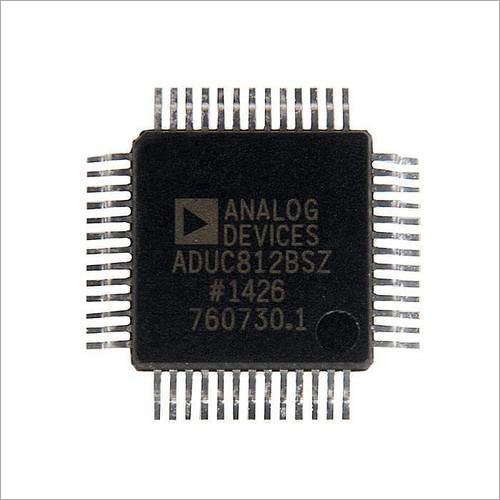
ADC Analog Digital Converter ICs
100 INR
Product Details:
- Interface Parallel or Serial (SPI/I2C)
- Usage Signal Processing, Data Acquisition
- Features Low Power, High Resolution, Fast Conversion
- Resolution 8/10/12 bits
- Power Source Electronic Circuit Supply
- Components Semiconductor, Pins
- Thermal Conductivity Standard for plastic ICs
- Click to View more
X
ADC Analog Digital Converter ICs Price And Quantity
- 100 INR
- 10 Piece
- Up to 1000 kSPS
- Internal/External selectable
- 2 kV (typical)
- ±0.5 LSB (typical)
- Through Hole or SMD
- 8, 14, 16 (depending on type)
- Compliant
- Up to 95% RH (non-condensing)
- 0.5 mW to 5 mW (depending on operation)
- 0 to Vref
- DIP/SOP/SSOP (varies by model)
- ±1 LSB (typical)
ADC Analog Digital Converter ICs Product Specifications
- Analog Signal
- DC
- Compatible with standard analog sensors
- Up to 8/10/12 bits
- Not Rated
- Digital Signal
- Microseconds range
- Approx 9mm x 6mm x 1.5mm
- Standard IC package thickness
- ADC Integrated Circuit
- 1 mA (typical)
- Up to 1MSPS (depending on model)
- 2.7V to 5.5V
- Approx 2g
- Semiconductor, Pins
- Standard for plastic ICs
- -40C to +85C
- 5V DC
- Signal Processing, Data Acquisition
- Black
- Small (Standard IC) Size
- Parallel or Serial (SPI/I2C)
- Microcontrollers, Data Loggers, Measurement Systems
- Electronic Circuit Supply
- Analog to Digital Conversion
- 8/10/12 bits
- Low Power, High Resolution, Fast Conversion
- Up to 1000 kSPS
- Internal/External selectable
- 2 kV (typical)
- ±0.5 LSB (typical)
- Through Hole or SMD
- 8, 14, 16 (depending on type)
- Compliant
- Up to 95% RH (non-condensing)
- 0.5 mW to 5 mW (depending on operation)
- 0 to Vref
- DIP/SOP/SSOP (varies by model)
- ±1 LSB (typical)
ADC Analog Digital Converter ICs Trade Information
- 3000 Piece Per Day
- 2-3 Days
- Yes
- Contact us for information regarding our sample policy
- All India
Product Description
ADC Analog Digital Converter ICs are widely installed for digital signal processing, in music recording systems, and scientific equipment. They are required for converting analog signals into digital form with utmost accuracy & reliability. These ICs are available in customizable configurations as requested by our clients according to specific needs. ADC Analog Digital Converter ICs offered by us have compact structural configuration and assure error-free performance. They have been tested on several quality parameters for assuring complete customer satisfaction.
Features:
- Precisely designed
- Completely trustworthy in nature
- Long service life
Technical Specification
| Speed | 16MHz |
| Voltage Supply | 2.7 V ~ 5.5 V (Vcc/Vdd) |
| Supplier Device Package | 52-MQFP (10x10) |
| RAM Size | 256 x 8 |
| Program Memory Type | Flash |
| Program Memory Size | 8KB (8K x 8) |
| Peripherals | PSM,Temp Sensor,WDT |
| Part Status | Active |
| Packaging | Cut Tape (CT) |
| Package Case | 52-QFP |
| Oscillator Type | Internal |
| Operating Temperature | -40 deg C ~ 85 deg C (TA) |
| Number of IO | 34 I/O |
| EEPROM Size | 640 x 8 |
| Data Converters | A/D 8x12b,D/A 2x12b |
| Core Size | 8-Bit |
| Core Processor | 8052 |
| Connectivity | I2C,SPI,UART/USART |
Advanced Signal Processing Capabilities
These ADC ICs enable high-speed, high-resolution analog-to-digital conversion with linearity error as low as 1 LSB and differential nonlinearity of 0.5 LSB (typical). With a conversion rate of up to 1000 kSPS and resolutions up to 12 bits, they are well-suited for applications requiring precise signal processing, including measurement systems, microcontrollers, and data acquisition platforms.
Flexible Integration and Mounting
The ICs are offered in DIP, SOP, or SSOP packages with 8, 14, or 16 pins, providing flexibility for both through-hole and SMD assembly. This ensures broad compatibility with various PCB layouts and assembly processes, making them convenient for manufacturers, designers, and assembly houses.
Designed for Rugged Industrial Environments
With an operating temperature range from -40C to +85C and up to 95% relative humidity resistance (non-condensing), these ICs perform reliably in demanding environments. The typical ESD protection rating of 2 kV further enhances durability against electrostatic discharge, making them suitable for industrial, laboratory, and field applications.
FAQs of ADC Analog Digital Converter ICs:
Q: How does the ADC IC convert analog signals to digital outputs?
A: The ADC IC samples the input analog voltage within the range of 0 to Vref and converts it into a digital code with resolutions up to 8, 10, or 12 bits. It utilizes internal or external reference voltages and supports fast conversion rates up to 1000 kSPS, ensuring precise representation of the analog input for microcontrollers and digital systems.Q: What are the advantages of using internal or external reference voltage in these ADC ICs?
A: Internal reference voltage offers simplified circuit design and consistent performance, while external reference voltage allows for calibration and adjustment to match application-specific accuracy or input ranges. Users can select based on their desired precision and system requirements.Q: When should I select DIP, SOP, or SSOP package types for my project?
A: DIP packages are ideal for prototyping or through-hole mounting, SOP and SSOP are preferred for space-constrained designs needing surface mount technology (SMD). Your choice depends on your PCB design, assembly process, and size constraints.Q: Where are these ADC ICs commonly used in India?
A: These ADC ICs are widely implemented in microcontrollers, data loggers, measurement devices, and various industrial and consumer electronics requiring analog signal digitization. They are available from authorized distributors, importers, manufacturers, and suppliers across India.Q: What is the typical process to use this ADC IC with a microcontroller?
A: To use the ADC IC, connect the analog sensor output to the input pin, set reference voltage (internal or external), supply recommended voltage (2.7V to 5.5V DC), and interface with the microcontroller using parallel or serial (SPI/I2C) connections. Digital data is then processed or logged as required by your application.Q: How does the low power consumption benefit battery-operated systems?
A: With power consumption ranging from 0.5 mW to 5 mW, these ADC ICs are highly suitable for battery-powered and portable devices. Their efficiency helps extend battery life while maintaining high-speed, accurate conversion.Tell us about your requirement

Price:
Quantity
Select Unit
- 50
- 100
- 200
- 250
- 500
- 1000+
Additional detail
Mobile number
Email

Other Products in 'Electronic Components' category



Contact Details
KK INTERNATIONAL
Mumbai, Maharashtra, India
Mumbai, Maharashtra, India

- Plot No. 305, Rajdeep Apartments, Tara Temple Lane, Near Lamington Road,Mumbai - 400007, Maharashtra, India
- Phone : 08045477473
- Mr Pratik Chouhan (Managing Director)
- Mobile : 08045477473
-
 Send Inquiry
 Send Inquiry
 Send Inquiry
 Send SMS
Quick Inquiry

 |
KK INTERNATIONAL
All Rights Reserved.(Terms of Use) Developed and Managed by Infocom Network Private Limited. |
