


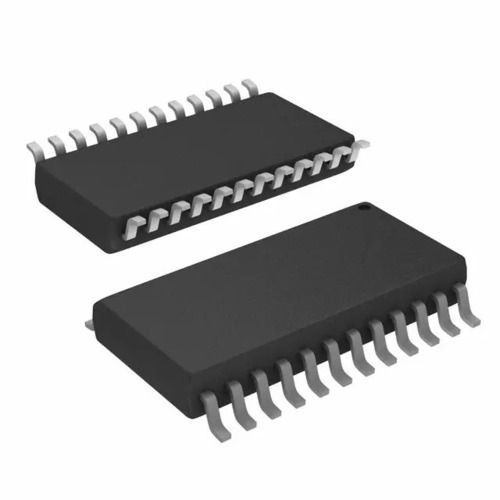
ADE7758AR
200 INR
Product Details:
- Product Type Energy Metering IC
- Application 3-Phase Energy Metering, Power Monitoring, Industrial and Commercial Metering Systems
- Supply Voltage 4.75V to 5.25V
- Dissipation Power Typical 100 mW
- Operating Temperature -40C to +85C
- Power Consumption Low
- Temperature Range -40C to +85C
- Click to View more
X
ADE7758AR Price And Quantity
- 200 INR
- 15 Piece
- SSOP (Shrink Small Outline Package)
- Typically 13 mA
- ADE7758AR
- Up to 3.579 MHz Crystal Supported
- 2.4V
- Class 1
- 6 (3 Voltage, 3 Current)
- Three Phase
- SPI Compatible
- Yes
- 24 pins
ADE7758AR Product Specifications
- Low
- Typical 100 mW
- 3-Phase Energy Metering, Power Monitoring, Industrial and Commercial Metering Systems
- -40C to +85C
- -40C to +85C
- Energy Metering IC
- Internal reference
- 4.75V to 5.25V
- 24-Lead SSOP Package
- 2V (analog input, typical)
- Approx. 0.2g
- SSOP (Shrink Small Outline Package)
- Typically 13 mA
- ADE7758AR
- Up to 3.579 MHz Crystal Supported
- 2.4V
- Class 1
- 6 (3 Voltage, 3 Current)
- Three Phase
- SPI Compatible
- Yes
- 24 pins
ADE7758AR Trade Information
- All India
Product Description
Specification
|
Base Part Number |
ADE7758 |
|
Mounting Type |
Surface Mount |
|
Voltage Supply |
4.75V ~ 5.25V |
|
Voltage IO Low |
0.8V |
|
Voltage IO High |
2.4V |
|
Supplier Device Package |
24-SOIC |
|
Part Status |
Active |
|
Packaging |
Tube |
|
Package Case |
24-SOIC (0.295",7.50mm Width) |
|
Operating Temperature |
-40 deg C ~ 85 deg C |
|
Meter Type |
3 Phase |
|
Measurement Error |
0.1% |
|
Input Impedance |
380 kOhm |
|
Current Supply |
8mA |
Advanced Three-Phase Energy Measurement
The ADE7758AR is designed for comprehensive energy analysis, providing precise measurement of active, reactive, and apparent power. Its class 1 accuracy ensures dependable data in energy metering applications. This high level of integration is ideal for 3-phase utility meters and industrial monitoring systems, supporting modern efficiency and grid management needs.
Flexible Interface and Integration
Featuring SPI compatibility and a 24-pin SSOP package, the ADE7758AR integrates seamlessly into existing designs. Its six analog inputs allow simultaneous voltage and current monitoring across three phases, simplifying board layouts while enabling robust system-level diagnostics. The devices compact form factor is suitable for tightly constrained installations.
Reliability Across Temperature Extremes
Engineered for reliability, the ADE7758AR operates efficiently from -40C to +85C. Its typical operating current of just 13 mA and on-chip 2.4V reference further enhance resilience and minimize the need for external components. These capabilities are particularly valuable for industrial and commercial environments with fluctuating environmental conditions.
FAQs of ADE7758AR:
Q: How can the ADE7758AR be integrated into a 3-phase energy metering system?
A: The ADE7758AR is designed for direct integration into three-phase energy meters. Its SPI-compatible interface facilitates communication with microcontrollers, while six analog inputs allow simultaneous measurement of three voltages and three currents. Reference designs and documentation provide step-by-step support for hardware and software integration.Q: What applications benefit most from using the ADE7758AR?
A: This IC is ideal for applications such as industrial and commercial power meter systems, three-phase utility sub-metering, and comprehensive energy monitoring in smart buildings. Its robust accuracy and wide temperature range also suit demanding environments requiring precise energy usage tracking.Q: Where can I source the ADE7758AR in India?
A: The ADE7758AR is available through authorized distributors, importers, manufacturers, suppliers, traders, and wholesalers across India. Many electronic component distributors support online ordering and provide technical support for integration.Q: When should I consider using the ADE7758AR over other similar ICs?
A: Choose the ADE7758AR when you require precise energy measurement (Class 1 accuracy), low power consumption, and reliable operation across industrial temperature ranges. Its integrated voltage reference, SPI compatibility, and 24-lead SSOP package make it suitable for both compact and highly reliable designs.Q: What are the benefits of the on-chip 2.4V reference in the ADE7758AR?
A: The internal 2.4V reference enhances measurement stability and accuracy while reducing the need for additional external components. This not only simplifies board design but also boosts overall device reliability in energy metering systems.Q: How does the ADE7758AR handle power consumption and efficiency?
A: Operating at a typical current of 13 mA with a typical power dissipation of 100 mW, the ADE7758AR is designed for low power consumption. This makes it ideal for large-scale deployments where energy efficiency and thermal management are crucial.Q: What is the process for interfacing the ADE7758AR with a microcontroller?
A: To interface with a microcontroller, use the ADE7758ARs SPI (Serial Peripheral Interface). Connect the appropriate SPI pins according to the datasheet, configure the controller to communicate with the device, and follow initialization routines as outlined in the reference manual to begin accurate real-time energy measurement.Tell us about your requirement

Price:
Quantity
Select Unit
- 50
- 100
- 200
- 250
- 500
- 1000+
Additional detail
Mobile number
Email

Other Products in 'Energy Metering IC' category


Contact Details
KK INTERNATIONAL
Mumbai, Maharashtra, India
Mumbai, Maharashtra, India

- Plot No. 305, Rajdeep Apartments, Tara Temple Lane, Near Lamington Road,Mumbai - 400007, Maharashtra, India
- Phone : 08045477473
- Mr Pratik Chouhan (Managing Director)
- Mobile : 08045477473
-
 Send Inquiry
 Send Inquiry
 Send Inquiry
 Send SMS
Quick Inquiry

 |
KK INTERNATIONAL
All Rights Reserved.(Terms of Use) Developed and Managed by Infocom Network Private Limited. |
