


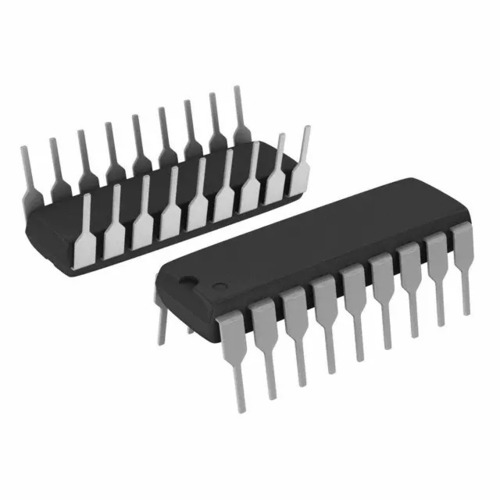
ADS1210P
600 INR
Product Details:
- Usage Precision Measurement, Weigh Scales, Data Acquisition
- Input Differential Analog Input
- Interface Serial, SPI-Compatible
- Operating Temperature -40C to 85C
- Output Serial Digital Output
- Power Supply Single Supply 5 V
- Sensors Specification Supports Low-Level Analog Sensors
- Click to View more
X
ADS1210P Price And Quantity
- 600 INR
- 10 Piece
- On-chip Programmable Gain (1,2,4,8,16,32,64,128)
- Up to 1 kSPS
- Yes
- 20-Pin Dual In-line (PDIP-20)
- Through Hole
- 1 Differential or 2 Single-Ended
- ADS1210P
- Yes, Optimized for Low Power
- 2 ppm of FSR
- >10 G
- 2.5 V (typical)
- 2.54 mm
ADS1210P Product Specifications
- External DC Supply
- DIP Package (Black)
- On-chip PGA, Low Noise, High Precision
- 5 V
- 24-bit resolution
- 24-Bit Analog-to-Digital Converter
- Programmable (Depends on Output Rate)
- Standard DIP
- Industrial Instrumentation, Process Control, Portable Instruments
- Approx. 1.5g
- 24 Bit
- Max 3 mA
- Main IC, Gold-Plated Pins
- 10 to 1000 Hz Output Data Rate
- Supports Low-Level Analog Sensors
- 26 mm x 6 mm x 5 mm (Approx.)
- Single Supply 5 V
- Standard DIP20
- +5 V DC
- Serial Digital Output
- Analog-to-Digital Converter IC
- -40C to 85C
- Differential Analog Input
- Serial, SPI-Compatible
- Precision Measurement, Weigh Scales, Data Acquisition
- On-chip Programmable Gain (1,2,4,8,16,32,64,128)
- Up to 1 kSPS
- Yes
- 20-Pin Dual In-line (PDIP-20)
- Through Hole
- 1 Differential or 2 Single-Ended
- ADS1210P
- Yes, Optimized for Low Power
- 2 ppm of FSR
- >10 G
- 2.5 V (typical)
- 2.54 mm
ADS1210P Trade Information
- All India
Product Description
Specification
| Architecture | Sigma-Delta |
| Voltage Supply Digital | 5V |
| Supplier Device Package | 18-PDIP |
| Sampling Rate | 16k (Per Second) |
| Reference Type | External, Internal |
| Part Status | Obsolete |
| Packaging | Tube |
| Package Case | 18-DIP (0.300", 7.62mm) |
| Operating Temperature | -40 deg C ~ 85 deg C |
| Number of Inputs | 1 |
| Number of Bits | 24 |
| Input Type | Differential |
| Features | PGA |
| Data Interface | SPI |
| Configuration | PGA-ADC |
| Base Part Number | ADS1210 |
High Precision Measurement
With its 24-bit resolution and 2 ppm linearity, the ADS1210P enables highly accurate measurements, essential for weight scales, laboratory instruments, and other precision applications. Its on-chip programmable gain amplifier further enhances signal quality, ensuring optimal performance even with low-level analog sensor inputs.
Versatile Programmable Features
Equipped with an on-chip programmable gain amplifier, the ADS1210P supports gain settings from 1 to 128. This flexibility allows it to adapt to various input signal strengths and applications from portable field devices to process control systems. Programmable response times and output data rates accommodate different system speeds and requirements.
Low Power and Robust Design
Optimized for low power consumption (maximum 3 mA current rating), the ADS1210P is suitable for battery-operated and portable applications. Its robust DIP-20 package with gold-plated pins offers reliable performance, simple through-hole mounting, and is built to withstand an extended industrial temperature range.
FAQs of ADS1210P:
Q: How do I configure the ADS1210P for different gain settings?
A: The ADS1210P features an on-chip programmable gain amplifier accessible via its SPI-compatible serial interface. You can set the gain to values of 1, 2, 4, 8, 16, 32, 64, or 128 during device initialization or operation, tailoring the input amplification to your applications requirements.Q: What are the usage benefits of the ADS1210P in industrial applications?
A: The main benefits include high-precision 24-bit resolution, ultra-high input impedance, low noise, and low power consumption. These attributes make it ideal for accurate data acquisition, process control, and sensor interfacing in harsh industrial environments.Q: When should I use the ADS1210Ps differential versus single-ended inputs?
A: Use the differential input for applications that require high noise immunity or when measuring small signals over long distances. Opt for the two single-ended channel configuration for applications needing multiple independent measurements from ground-referenced sources.Q: Where can I integrate the ADS1210P in my design?
A: The ADS1210P can be integrated anywhere high-resolution analog-to-digital conversion is required, such as weigh scales, industrial process controllers, laboratory data loggers, and portable measurement devices. Its standard DIP-20 package ensures ease of use in both evaluation boards and production units.Q: What interfaces does the ADS1210P support for data communication?
A: The ADS1210P provides a serial digital output compatible with SPI protocols. This facilitates seamless connection with most microcontrollers and digital processing systems.Q: How does the ADS1210P maintain high precision with low-level sensors?
A: Its high input impedance (>10 G), low noise design, and programmable gain amplifier allow accurate measurement of weak sensor signals, preserving data fidelity and ensuring excellent accuracy even in challenging situations.Q: Is the ADS1210P compliant with environmental and safety regulations?
A: Yes, the ADS1210P is RoHS compliant, featuring environmentally friendly construction. Its robust DIP-20 package and gold-plated pins also ensure long-lasting, reliable performance in industrial settings.Tell us about your requirement

Price:
Quantity
Select Unit
- 50
- 100
- 200
- 250
- 500
- 1000+
Additional detail
Mobile number
Email

Other Products in 'Burr - Brown ICs' category



Contact Details
KK INTERNATIONAL
Mumbai, Maharashtra, India
Mumbai, Maharashtra, India

- Plot No. 305, Rajdeep Apartments, Tara Temple Lane, Near Lamington Road,Mumbai - 400007, Maharashtra, India
- Phone : 08045477473
- Mr Pratik Chouhan (Managing Director)
- Mobile : 08045477473
-
 Send Inquiry
 Send Inquiry
 Send Inquiry
 Send SMS
Quick Inquiry

 |
KK INTERNATIONAL
All Rights Reserved.(Terms of Use) Developed and Managed by Infocom Network Private Limited. |
