


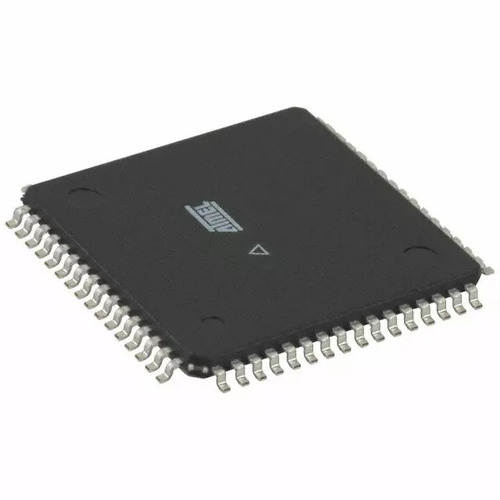
ATMEGA64A-AU
80 INR
Product Details:
- Features Low Power Consumption, In-System Programmable, 8-bit AVR RISC Architecture
- Usage Embedded System and Electronic Applications
- Power Supply 3.3V to 5.5V
- Processor Speed 16 MIPS (at 16 MHz)
- Power Source DC Supply
- Output Digital / Analog via GPIO Pins
- Components AVR CPU Core, Flash, EEPROM, SRAM
- Click to View more
X
ATMEGA64A-AU Price And Quantity
- 80 INR
- 10 Piece
- 80.00 - 120.00 INR
- 8-channel 10-bit ADC
- 4 KB
- 64 KB In-System Self-Programmable Flash
- 8
- 2 KB
- TQFP-64 (Thin Quad Flat Package)
- 20 Years at 85°C / 100 Years at 25°C (Flash/EEPROM)
- Yes
- 4 (2x 8-bit, 2x 16-bit)
- ISP, JTAG, Parallel
- 10
- Programmable with Separate On-chip Oscillator
- External Crystal/Oscillator up to 16 MHz
- 53
ATMEGA64A-AU Product Specifications
- Typical 10 mA (Active); 0.5 uA (Power-down)
- USART, SPI, I2C (TWI), JTAG
- Black (IC Body)
- 1.2 mm (typical IC body)
- 64 KB Flash Memory
- AVR CPU Core, Flash, EEPROM, SRAM
- Digital / Analog via GPIO Pins
- 2.7V to 5.5V
- Digital / Analog via GPIO Pins
- Approx. 0.6g
- Microcontroller IC
- Industrial Control, Automation, Consumer Electronics
- 10-bit ADC Resolution
- 7 mm x 7 mm x 1.2 mm
- 7 mm x 7 mm (package)
- Up to 16 MHz
- -40C to +85C
- Microcontroller Unit
- 3.3V to 5.5V
- Low Power Consumption, In-System Programmable, 8-bit AVR RISC Architecture
- 5V
- Embedded System and Electronic Applications
- DC Supply
- 16 MIPS (at 16 MHz)
- 8-channel 10-bit ADC
- 4 KB
- 64 KB In-System Self-Programmable Flash
- 8
- 2 KB
- TQFP-64 (Thin Quad Flat Package)
- 20 Years at 85°C / 100 Years at 25°C (Flash/EEPROM)
- Yes
- 4 (2x 8-bit, 2x 16-bit)
- ISP, JTAG, Parallel
- 10
- Programmable with Separate On-chip Oscillator
- External Crystal/Oscillator up to 16 MHz
- 53
ATMEGA64A-AU Trade Information
- All India
Product Description
Specification
| Base Part Number | ATMEGA64 |
| Speed | 16MHz |
| Voltage Supply | 2.7 V ~ 5.5 V (Vcc/Vdd) |
| Supplier Device Package | 64-TQFP (14x14) |
| RAM Size | 4K x 8 |
| Program Memory Type | Flash |
| Program Memory Size | 64KB (32K x 16) |
| Peripherals | Brown-out Detect/Reset, POR, PWM, WDT |
| Part Status | Active |
| Packaging | Cut Tape (CT) |
| Package Case | 64-TQFP |
| Oscillator Type | Internal |
| Operating Temperature | -40 deg C ~ 85 deg C (TA) |
| Number of IO | 53 I/O |
| EEPROM Size | 2K x 8 |
| Data Converters | A/D 8x10b |
| Core Size | 8-Bit |
| Core Processor | AVR |
| Connectivity | I2C, SPI, UART/USART |
Versatile Memory and Processing Power
With 64 KB flash memory, 4 KB SRAM, and 2 KB EEPROM, the ATMEGA64A-AU delivers ample space for firmware, data storage, and application variables. Its AVR RISC core reaches processing speeds of up to 16 MIPS at 16 MHz, providing reliable performance for real-world embedded systems ranging from industrial control units to smart consumer devices.
Flexible Interface and I/O Options
Supporting USART, SPI, I2C (TWI), and JTAG, this microcontroller ensures seamless communication with sensors, displays, and other components. The 53 I/O pins, eight PWM channels, and eight 10-bit ADC inputs offer designers flexibility to implement sophisticated control and measurement tasks in automation and electronics projects.
Robust Operation and Low Power Consumption
Operating from -40C to +85C and supporting supply voltages between 2.7V and 5.5V, the ATMEGA64A-AU is ready for harsh and variable environments. Its brown-out detection, programmable watchdog timer, and power-down modes keep power consumption minimal (as low as 0.5 A), maximizing efficiency in battery-powered applications.
FAQs of ATMEGA64A-AU:
Q: How can I program the ATMEGA64A-AU microcontroller?
A: You can program the ATMEGA64A-AU using In-System Programming (ISP), JTAG, or parallel programming interfaces. The in-system self-programmable flash allows updates without removing the chip from your circuit, simplifying firmware upgrades during development and deployment.Q: What applications is the ATMEGA64A-AU best suited for?
A: Thanks to its robust features, including numerous I/O pins, versatile connectivity, and low power consumption, the ATMEGA64A-AU excels in embedded system designs such as industrial control, automation, and consumer electronics, where reliability and flexibility are critical.Q: When should I use the 8-channel 10-bit ADC on the ATMEGA64A-AU?
A: The integrated 8-channel, 10-bit ADC is ideal when your application requires multiple analog measurementsfor example, reading sensor values, monitoring voltages, or processing analog inputs. It streamlines the process by eliminating the need for external ADC components.Q: Where can I source the ATMEGA64A-AU microcontroller in India?
A: Distributors, importers, manufacturers, suppliers, traders, and wholesalers throughout India stock the ATMEGA64A-AU. These include well-known electronic component suppliers who carry genuine and authenticated stock for both small and large volume requirements.Q: What benefits does the TQFP-64 package type offer for my project?
A: The TQFP-64 (Thin Quad Flat Package) provides a compact physical footprint (7 mm x 7 mm), making it optimal for densely populated PCB designs. Its design simplifies automated manufacturing and is well-suited for high-volume electronic production.Q: How does the ATMEGA64A-AU ensure reliable operation in varied power environments?
A: The microcontroller supports a wide supply voltage range (2.7V to 5.5V) and features brown-out detection and a programmable watchdog timer. This combination safeguards against voltage fluctuations and system hangs, maintaining reliable function in industrial and portable devices.Q: What is the process for implementing communication protocols like SPI and I2C on this microcontroller?
A: The ATMEGA64A-AU includes dedicated hardware modules for SPI and I2C (TWI), enabling straightforward setup via configuration registers in your firmware. These protocols facilitate fast and reliable communication with peripherals such as sensors, memory chips, and displays.Tell us about your requirement

Price:
Quantity
Select Unit
- 50
- 100
- 200
- 250
- 500
- 1000+
Additional detail
Mobile number
Email

Other Products in 'Atmel ICS' category




Contact Details
KK INTERNATIONAL
Mumbai, Maharashtra, India
Mumbai, Maharashtra, India

- Plot No. 305, Rajdeep Apartments, Tara Temple Lane, Near Lamington Road,Mumbai - 400007, Maharashtra, India
- Phone : 08045477473
- Mr Pratik Chouhan (Managing Director)
- Mobile : 08045477473
-
 Send Inquiry
 Send Inquiry
 Send Inquiry
 Send SMS
Quick Inquiry

 |
KK INTERNATIONAL
All Rights Reserved.(Terms of Use) Developed and Managed by Infocom Network Private Limited. |
