


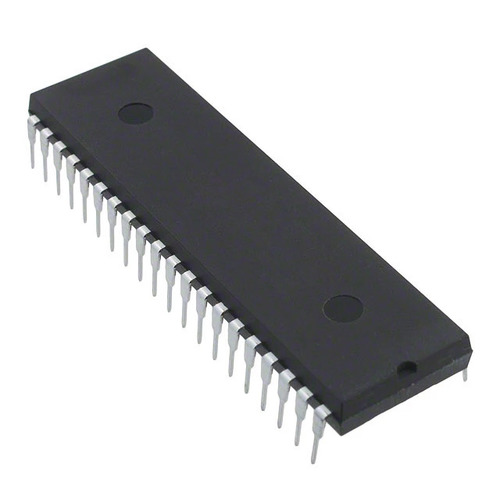
ATMEGA8515-16PI
110 INR
Product Details:
- Power Source External DC supply
- Processor Speed 16 MHz Max
- Operating Temperature -40C to +85C
- Components ATMEGA8515 core with integrated peripherals
- Response Time Fast, dependent on instruction cycle
- Output Digital
- Sensors Specification No dedicated sensor interface
- Click to View more
X
ATMEGA8515-16PI Price And Quantity
- 10 Piece
- 110.00 - 150.00 INR
- 110 INR
- Plastic
- AVR enhanced RISC
- Yes
- Flash
- 8 bits
- External Crystal up to 16 MHz
- In-System Programmable (ISP)
- 512 bytes
- 512 bytes
- 2 x 8-bit, 1 x 16-bit Timer/Counters
- 4 channels
- ATmega8515
- 32
- No ADC
- DIP-40
- 40
ATMEGA8515-16PI Product Specifications
- ATMEGA8515 core with integrated peripherals
- 5V DC
- -40C to +85C
- DIP-40 package; 52.5mm x 13.5mm x 4.0mm (approx.)
- DIP-40
- External DC supply
- 4.5V to 5.5V
- 16 MHz Max
- Approx. 3g
- 8 bits
- Standard DIP Package
- Digital
- 8KB Flash Memory
- Up to 20 mA per I/O pin
- Embedded Systems, Industrial Control, Robotics, Consumer Electronics
- 32 Programmable I/O Lines, In-System Programmable, Enhanced RISC Architecture, Watchdog Timer, External and Internal Interrupts
- 16 MHz
- DC
- USART, SPI, I2C, JTAG
- Black
- Fast, dependent on instruction cycle
- 8-bit Microcontroller
- Digital
- High Performance AVR Microcontroller
- Microcontroller development, Data acquisition, Hardware Projects
- No dedicated sensor interface
- Plastic
- AVR enhanced RISC
- Yes
- Flash
- 8 bits
- External Crystal up to 16 MHz
- In-System Programmable (ISP)
- 512 bytes
- 512 bytes
- 2 x 8-bit, 1 x 16-bit Timer/Counters
- 4 channels
- ATmega8515
- 32
- No ADC
- DIP-40
- 40
ATMEGA8515-16PI Trade Information
- All India
Product Description
Specification
| Base Part Number | AT90S4433 |
| Speed | 8MHz |
| Voltage Supply | 4 V ~ 6 V (Vcc/Vdd) |
| Supplier Device Package | 28-PDIP |
| RAM Size | 128 x 8 |
| Program Memory Type | Flash |
| Program Memory Size | 4KB (2K x 16) |
| Peripherals | Brown-out Detect/Reset, POR, PWM, WDT |
| Part Status | Obsolete |
| Packaging | Tube |
| Package Case | 28-DIP (0.300", 7.62mm) |
| Oscillator Type | External |
| Operating Temperature | 0 deg C ~ 70 deg C |
| Number of IO | 20 I/O |
| EEPROM Size | 256 x 8 |
| Data Converters | A/D 6x10b |
| Core Size | 8-Bit |
| Core Processor | AVR |
| Connectivity | SPI, UART/USART |
Robust Performance for Diverse Applications
The ATMEGA8515-16PI microcontroller excels in real-time applications, from automation to consumer electronics. Its enhanced AVR RISC architecture ensures fast instruction execution cycles, and its 8KB of Flash memory supports complex firmware projects. The DIP-40 plastic package offers durability and easy handling, making it ideal for prototyping and medium-scale production environments.
Flexible I/O and Peripheral Integration
With 32 programmable I/O lines, the ATMEGA8515-16PI accommodates numerous connectivity and control tasks. Three timers (two 8-bit, one 16-bit) and four PWM channels allow for precise timing and signal generation. Its broad interfacing optionsUSART, SPI, I2C, JTAGenable seamless integration into multifaceted embedded systems and industrial applications.
FAQs of ATMEGA8515-16PI:
Q: How can I program the ATMEGA8515-16PI microcontroller?
A: Programming the ATMEGA8515-16PI is convenient due to its In-System Programmable (ISP) capability. It allows firmware uploading directly through a compatible ISP programmer while the device remains mounted on your PCB, enhancing development and maintenance efficiency.Q: What are the main benefits of using the ATMEGA8515-16PI in embedded systems?
A: This microcontroller offers enhanced RISC architecture for fast response times, 32 versatile I/O pins, multiple communication protocols, and a robust 8KB Flash memory for stable code storage. Its DIP-40 package and wide operating temperature range enable reliable performance across various industrial and educational applications.Q: When is the ATMEGA8515-16PI most suitable for use in a project?
A: The ATMEGA8515-16PI is ideal when you require moderate program memory, a range of digital I/O lines, precise timing, and PWM output. Its especially suited for robotics, data acquisition, and control systems, as well as development and prototyping tasks.Q: Where can I use the ATMEGA8515-16PI microcontroller?
A: This device is widely used in embedded system development, industrial control units, robotics, and consumer electronics. Its flexibility and ease of use make it popular among designers and engineers in both commercial and academic environments across India and globally.Q: What is the process for connecting external sensors or modules to the ATMEGA8515-16PI?
A: Connectivity is straightforward using the available 32 I/O pins, which support standard digital input/output functions. Communication with modules is facilitated via USART, SPI, I2C, and JTAG interfaces, while PWM and timer/counter features manage actuators or signal processing tasks.Q: How does the absence of an ADC affect my application design?
A: Since the ATMEGA8515-16PI does not include a built-in ADC, analog sensors require an external analog-to-digital converter. This fosters design flexibilitywhether integrating precise external ADCs for custom data acquisition or focusing on digital signal projects without analog inputs.Q: What advantages does the ATMEGA8515-16PI offer over similar microcontrollers?
A: Key advantages include its broad supply voltage range (4.5V to 5.5V), ISP support for in-circuit updates, multiple timers, dedicated PWM channels, strong UART/SPI/I2C connectivity, and proven reliability within harsh environments, making it a robust choice for demanding embedded tasks.Tell us about your requirement

Price:
Quantity
Select Unit
- 50
- 100
- 200
- 250
- 500
- 1000+
Additional detail
Mobile number
Email

Other Products in 'Atmel ICS' category



Contact Details
KK INTERNATIONAL
Mumbai, Maharashtra, India
Mumbai, Maharashtra, India

- Plot No. 305, Rajdeep Apartments, Tara Temple Lane, Near Lamington Road,Mumbai - 400007, Maharashtra, India
- Phone : 08045477473
- Mr Pratik Chouhan (Managing Director)
- Mobile : 08045477473
-
 Send Inquiry
 Send Inquiry
 Send Inquiry
 Send SMS
Quick Inquiry

 |
KK INTERNATIONAL
All Rights Reserved.(Terms of Use) Developed and Managed by Infocom Network Private Limited. |
