


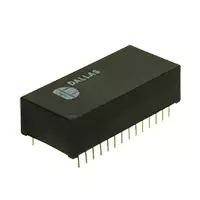
DS1644
600 INR
Product Details:
- Usage Nonvolatile RAM for data retention and real-time clock applications
- IP Rating Not rated
- Input Digital data (address/data bus)
- Output Digital data (address/data bus)
- Components SRAM, Real-time Clock, Battery
- Operating Temperature 0C to +70C
- Interface Parallel (address/data bus)
- Click to View more
X
DS1644 Price And Quantity
- 600 INR
- 10 Piece
- Through Hole (DIP)
- 100 mA (active)
- Embedded lithium cell
- 28
- Human body model >2000V
- 10 years minimum with battery
- +/-1 minute per month at 25°C
- Plastic DIP
- 8 bits
- Seconds, minutes, hours, day, date, month, year, leap year compensation
- Obsolete/No longer in production
- 32768 x 8 bits
DS1644 Product Specifications
- 5V DC
- Integrated RTC, battery backup, 10 years data retention, drop-in replacement
- 100mA (active), 1mA (standby)
- 4.5V to 5.5V
- 32.768 kHz (crystal oscillator)
- Approx. 16 grams
- Battery or external DC
- Battery included (lithium) + External DC power
- Black
- 32 Kbytes (256K-bit)
- Access time: 100 ns
- Timekeeping and data storage (Timekeeper RAM)
- Digital data (address/data bus)
- Timekeeping RAM module
- Industrial, embedded systems, computers, instrumentation
- Nonvolatile RAM for data retention and real-time clock applications
- Digital data (address/data bus)
- Not rated
- Parallel (address/data bus)
- 36 mm x 18 mm x 16 mm
- 0C to +70C
- SRAM, Real-time Clock, Battery
- 28-pin DIP
- Approx. 0.6 inch
- Through Hole (DIP)
- 100 mA (active)
- Embedded lithium cell
- 28
- Human body model >2000V
- 10 years minimum with battery
- +/-1 minute per month at 25°C
- Plastic DIP
- 8 bits
- Seconds, minutes, hours, day, date, month, year, leap year compensation
- Obsolete/No longer in production
- 32768 x 8 bits
Product Description
Specification
| Base Part Number | DS1644 |
| Features | Leap Year,NVSRAM |
| Type | Clock/Calendar |
| Mounting Type | Through Hole |
| Voltage Supply | 4.5 V ~ 5.5 V |
| Time Format | HHMMSS (24 hr) |
| Supplier Device Package | 28-EDIP |
| Part Status | Obsolete |
| Packaging | Tube |
| Package Case | 28-DIP Module (0.600",15.24mm) |
| Operating Temperature | 0 deg C ~ 70 deg C |
| Memory Size | 32KB |
| Interface | Parallel |
| Date Format | YY-MM-DD-dd |
| Current Timekeeping Max | 4mA @ 4.5V ~ 5.5V |
Integrated Timekeeping and Data Storage Solution
DS1644 combines real-time clock functions with nonvolatile SRAM, streamlining the design process for systems requiring both precise timekeeping and reliable data retention. Its embedded battery ensures continuity, even during power disruptions, making it perfect for critical industrial and embedded applications.
Reliable Power and Longevity
The onboard lithium cell guarantees continuous operation for at least 10 years without external power, safeguarding stored data. With a rated supply voltage of 5V DC and current options for active and standby operation, DS1644 offers exceptional endurance and low-maintenance performance in demanding environments.
Simple Installation and Universal Compatibility
Featuring a through-hole 28-pin DIP footprint, the DS1644 is easily integrated into legacy and new PCB designs. The parallel bus interface allows seamless communication with common microprocessors, making it an excellent drop-in replacement for many systems requiring both real-time clock and SRAM functionalities.
FAQs of DS1644:
Q: How does the DS1644 maintain data retention during power loss?
A: The DS1644 is equipped with an embedded lithium cell that enables the device to preserve stored data and timekeeping functions for a minimum of 10 years, even when external DC power is unavailable. This makes it highly reliable for applications where data loss cannot be tolerated.Q: What are the primary functions provided by the DS1644 module?
A: The DS1644 serves as both a nonvolatile SRAM (32 Kbytes) and a real-time clock, offering second-to-year timekeeping, leap year compensation, and calendar features. It combines data storage and timing in one compact solution suitable for various industrial and embedded applications.Q: Where can DS1644 modules be used?
A: DS1644 modules are ideal for use in industrial control systems, embedded computers, instrumentation, and any application that requires nonvolatile memory with real-time clock functions. Despite being discontinued, they are still supported for replacement in legacy equipment throughout India by distributors and suppliers.Q: When is it beneficial to use the DS1644 over separate SRAM and RTC components?
A: Choosing the DS1644 is beneficial when board space is limited, simplification of design is desired, and highly reliable backup protection is required. Its integrated RTC and SRAM, combined with battery backup, reduce component count and wiring complexity in critical systems.Q: What is the maximum supply current of the DS1644 and its operational voltage range?
A: During active operation, the DS1644 draws up to 100 mA, while standby current is typically 1 mA. Its operational voltage range is from 4.5V to 5.5V DC, making it compatible with standard 5V logic systems.Q: How is the DS1644 typically mounted in a system?
A: The device utilizes a through-hole design with a 28-pin plastic DIP package, allowing it to be securely mounted on printed circuit boards using standard DIP sockets or direct soldering for robust, reliable connections.Q: What interface is required to communicate with the DS1644?
A: Communication with the DS1644 is achieved through a parallel interface using address and data buses (8-bit width). This supports fast data access with a typical access time of 100 ns, suitable for most legacy and embedded systems.Tell us about your requirement

Price:
Quantity
Select Unit
- 50
- 100
- 200
- 250
- 500
- 1000+
Additional detail
Mobile number
Email

Other Products in 'Dallas ICs' category




Contact Details
KK INTERNATIONAL
Mumbai, Maharashtra, India
Mumbai, Maharashtra, India

- Plot No. 305, Rajdeep Apartments, Tara Temple Lane, Near Lamington Road,Mumbai - 400007, Maharashtra, India
- Phone : 08045477473
- Mr Pratik Chouhan (Managing Director)
- Mobile : 08045477473
-
 Send Inquiry
 Send Inquiry
 Send Inquiry
 Send SMS
Quick Inquiry

 |
KK INTERNATIONAL
All Rights Reserved.(Terms of Use) Developed and Managed by Infocom Network Private Limited. |
