


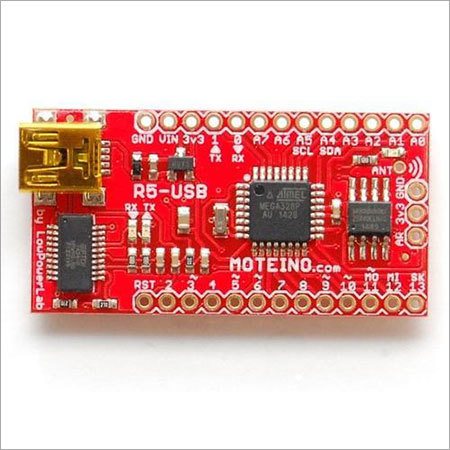
Flash Microcontroller
500 INR/Piece
Product Details:
- Min. Line Spacing 0.1 mm
- Hole Size 0.3 mm
- Impedance Controlled 50
- Board Type Rigid
- Soldermask LPI Green
- Voltage Endurance 500V
- Min. Line Width 0.1 mm
- Click to View more
X
Flash Microcontroller Price And Quantity
- 10 Piece
- 500 INR/Piece
- 200.00 - 2000.00 INR/Piece
- LQFP-48
- 4 KB
- SWD, ISP
- ARM Cortex-M Series
- -40°C to 85°C
- Yes
- USART, SPI, I2C, PWM, ADC, DAC
- 2.0V to 3.6V
- Integrated
- Low Power Modes Supported
- 20 KB
- Up to 72 MHz
- 32
- 128 KB
Flash Microcontroller Product Specifications
- 1 oz
- 500V
- 1.6 mm
- LPI Green
- UL94V-0
- White, both sides
- 2
- 0.1 mm
- 18 x 24
- >10^12
- Integrated digital and analog sensor support
- 0.3 mm
- Flash Microcontroller
- 0.1 mm
- FR4
- HASL (Lead-Free)
- Rigid
- Controlled 50
- 32-bit core, Flash memory, RAM, I/O ports
- 100% E-Test & AOI
- Green
- LQFP-48
- 4 KB
- SWD, ISP
- ARM Cortex-M Series
- -40°C to 85°C
- Yes
- USART, SPI, I2C, PWM, ADC, DAC
- 2.0V to 3.6V
- Integrated
- Low Power Modes Supported
- 20 KB
- Up to 72 MHz
- 32
- 128 KB
Flash Microcontroller Trade Information
- Cash Against Delivery (CAD), Cash in Advance (CID)
- All India
Product Description
We have marked a distinct position in the domain by supplying our clients Flash Microcontroller. It is a type of nonvolatile memory that erases data in units called blocks. A block stored on a flash memory chip must be erased before data can be written or programmed to the microchip. Flash memory retains data for an extended period of time, regardless of whether a flash-equipped device is powered on or off. Flash Microcontroller is used in enterprise server, storage and networking technology.
Features:
8 single-ended channel
High endurance non-volatile memory segments
Fully static operation
Frequently Asked Questions:
1) What does it mean to flash a microcontroller?
Flashing is the process of moving our program into the microcontroller's (persistent) memory. Once flashed, the microcontroller will execute the flashed program every time it is powered on.
2) What is flash memory used for in microcontroller?
Sometimes referred to as an embedded controller or microcontroller unit (MCU), microcontrollers are found in vehicles, robots, office machines, medical devices, mobile radio transceivers, vending machines and home appliances, among other devices.
3) What is flash and its uses?
Adobe Flash is a software platform used to create rich digital content containing animation, graphic effects, streaming video and other interactive elements to deliver engaging user experiences over many platforms, including desktops and mobile devices.
4) Why is it called flash memory?
According to Toshiba, the name flash was suggested because the erasure process of the memory contents reminded him of the flash of a camera.
Technical Specification
Humidity | 40% to 90% |
Color | Black |
Use | Electrical Devices |
Working Temperature | 0 to 50 Degree C |
Material Type | Semiconductor |
Advanced ARM Cortex-M Architecture
Built on the ARM Cortex-M series platform, this microcontroller delivers dependable performance for demanding real-time applications. Its 32-bit core and up to 72 MHz speed ensure efficient processing power, making it suitable for embedded solutions requiring rapid decision-making and multitasking capabilities.
Comprehensive Peripheral Support
Equipped with a variety of peripherals such as USART, SPI, I2C, PWM, ADC, and DAC, this microcontroller facilitates robust connectivity and control. This support allows seamless integration with external devices and sensors, enhancing overall design flexibility for your projects.
Low-Power, Reliable Operation
Designed to operate in harsh conditions with temperatures from -40C to 85C and a voltage range of 2.0V3.6V, the controller also supports low-power modes to maximize energy savings. Integrated ESD protection and certifications like UL94V-0 flame resistance ensure safety and reliability.
FAQs of Flash Microcontroller:
Q: How can I program the Flash Microcontroller, and what interfaces are supported?
A: Programming is straightforward using either SWD (Serial Wire Debug) or ISP (In-System Programming) interfaces, providing flexibility for development and debugging processes.Q: What are the primary benefits of using this microcontroller in my design?
A: You gain fast processing, ample Flash and RAM, support for diverse peripherals, integrated sensor capability, and low power operation, along with high reliability due to advanced testing (100% E-Test & AOI) and robust safety standards.Q: Where is this Flash Microcontroller available and what kind of companies distribute it?
A: This microcontroller is available across India through authorized distributors, importers, manufacturers, suppliers, traders, and wholesalers, ensuring easy procurement for various industrial and commercial needs.Q: When should I choose this microcontroller for my application?
A: Select this device when your application demands high-speed performance, wide operating temperature, significant memory, multi-peripheral integration, low-power requirements, and robust build quality.Q: What is the process for integrating digital and analog sensors with this microcontroller?
A: Thanks to built-in ADC and DAC peripherals and versatile I/O support, connecting sensors involves direct wiring and configuring the respective interfaces via firmware. The controllers integrated support ensures reliable data acquisition and response.Q: How does the microcontroller guarantee safety and performance for industrial environments?
A: With integrated ESD protection, RoHS compliance, UL94V-0 flame resistance, and extensive testing (E-Test & AOI), the device is engineered for optimal safety and durability in challenging environments.Tell us about your requirement

Price:
Quantity
Select Unit
- 50
- 100
- 200
- 250
- 500
- 1000+
Additional detail
Mobile number
Email

Other Products in 'Microcontroller IC' category




Contact Details
KK INTERNATIONAL
Mumbai, Maharashtra, India
Mumbai, Maharashtra, India

- Plot No. 305, Rajdeep Apartments, Tara Temple Lane, Near Lamington Road,Mumbai - 400007, Maharashtra, India
- Phone : 08045477473
- Mr Pratik Chouhan (Managing Director)
- Mobile : 08045477473
-
 Send Inquiry
 Send Inquiry
 Send Inquiry
 Send SMS
Quick Inquiry

 |
KK INTERNATIONAL
All Rights Reserved.(Terms of Use) Developed and Managed by Infocom Network Private Limited. |
