


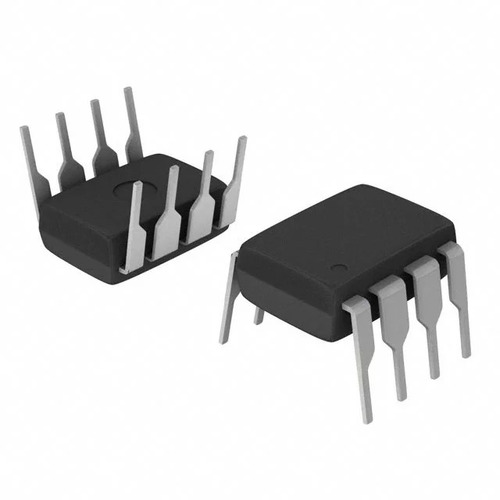
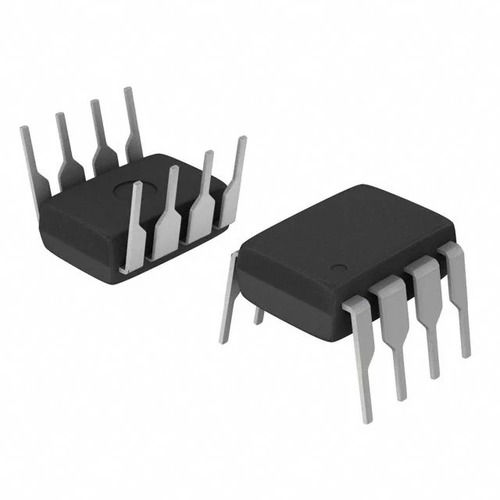
INA126P
200 INR
Product Details:
- Interface Through Hole
- Response Time Fast Settling: 8s to 0.01%
- Resolution Precision Analog
- Operating Temperature -40C to +85C
- Components Monolithic IC
- Power Source DC supply
- Output Single-ended Output
- Click to View more
X
INA126P Price And Quantity
- 10 Piece
- 200 INR
- Excellent for instrumentation apps
- 8-pin DIP (Plastic) / 8-pin SOIC
- 5nA typ
- Through Hole
- 94dB typ (G 10)
- 250V typ
- 1 to 10,000
- 100pF max
- 8 pins
- Yes
INA126P Product Specifications
- Standard DIP
- Precision Analog
- 2.25V to 18V or 4.5V to 36V
- 1mA typ (quiescent current)
- -40C to +85C
- Amplification of low-level signals in test, measurement, medical, and industrial devices
- Monolithic IC
- 9.8mm x 7.2mm x 3.3mm (DIP-8)
- DC supply
- DIP-8 / SOIC-8
- Through Hole
- Approx. 1.2g
- Fast Settling: 8s to 0.01%
- Precision Instrumentation Amplifier
- Rail-to-rail output, low offset voltage, low power, adjustable gain
- Differential Input
- Single-ended Output
- Signal amplification, precision measurement
- Single or Dual Supply
- 18V max
- Black / Standard IC package
- Bandwidth 140kHz
- Operational Amplifier IC
- Excellent for instrumentation apps
- 8-pin DIP (Plastic) / 8-pin SOIC
- 5nA typ
- Through Hole
- 94dB typ (G 10)
- 250V typ
- 1 to 10,000
- 100pF max
- 8 pins
- Yes
INA126P Trade Information
- All India
Product Description
Specification
| Amplifier Type | Instrumentation |
| Mounting Type | Through Hole |
| Voltage Supply Single Dual | 2.7 V ~ 36 V, +-1.35 V ~ 18 V |
| Voltage Input Offset | 100uV |
| Three db Bandwidth | 200kHz |
| Supplier Device Package | 8-PDIP |
| Slew Rate | 0.4 V/us |
| Part Status | Active |
| Packaging | Tube |
| Package Case | 8-DIP (0.300", 7.62mm) |
| Operating Temperature | -40 deg C ~ 85 deg C |
| Number of Circuits | 1 |
| Current Supply | 175uA |
| Current Output Channel | 10mA |
| Current Input Bias | 10nA |
| Base Part Number | INA126 |
Exceptional Precision for Low-Level Signal Amplification
The INA126P delivers outstanding signal integrity for demanding measurement scenarios. Its excellent linearity, low bias current, and high common mode rejection are especially suited for instrumentation roles where precision is critical. Designed with flexible mounting options, this amplifier accommodates both through-hole and SMD needs, ensuring compatibility across a variety of electronic projects.
Versatile Applications Across Industries
Engineered for performance in test, measurement, medical, and industrial devices, the INA126P can handle differential input signals and provide single-ended outputs. Its robust voltage rating and wide operating temperature range make it stable and reliable even under challenging environmental conditions.
FAQs of INA126P:
Q: How do I set the gain of the INA126P instrumentation amplifier?
A: The gain of the INA126P is easily adjustable by connecting a single external resistor between the gain pins. The gain can be set anywhere from 1 to 10,000, depending on application requirements. Refer to the datasheet for the specific gain equation and recommended resistor values.Q: What applications can benefit most from using the INA126P?
A: The INA126P is ideal for amplifying low-level signals in test and measurement equipment, medical instrumentation, and industrial monitoring systems due to its low input offset voltage, excellent linearity, and high common mode rejection.Q: When should I use a precision instrumentation amplifier like the INA126P instead of a standard op-amp?
A: Use the INA126P when precise amplification of small differential signals in the presence of large common mode voltages is required. Its specialized architecture offers lower offset, higher CMRR, and better accuracy compared to standard op-amps.Q: Where can I mount the INA126P in my circuit design?
A: The INA126P is available in both through-hole (DIP-8) and surface mount (SOIC-8) packages, providing flexibility for mounting on standard or compact PCBs in a wide range of applications.Q: What is the typical input offset voltage of the INA126P?
A: The typical input offset voltage of the INA126P is 250V, ensuring accurate signal amplification with minimal error, making it highly suitable for precision measurement applications.Q: How does the INA126P ensure excellent linearity and fast response time?
A: Its monolithic IC design, precision internal components, and optimal compensation help deliver linear signal amplification and a fast settling time of just 8s to 0.01%, which is valuable in high-speed measurement systems.Q: What are the key benefits of using the INA126P in signal conditioning circuits?
A: Key benefits include high accuracy due to low offset and bias currents, adjustable gain for versatile applications, robust CMRR for improved noise rejection, rail-to-rail output for maximum signal swing, and reliable operation across wide temperatures and voltage ranges.Tell us about your requirement

Price:
Quantity
Select Unit
- 50
- 100
- 200
- 250
- 500
- 1000+
Additional detail
Mobile number
Email

Other Products in 'Burr - Brown ICs' category



Contact Details
KK INTERNATIONAL
Mumbai, Maharashtra, India
Mumbai, Maharashtra, India

- Plot No. 305, Rajdeep Apartments, Tara Temple Lane, Near Lamington Road,Mumbai - 400007, Maharashtra, India
- Phone : 08045477473
- Mr Pratik Chouhan (Managing Director)
- Mobile : 08045477473
-
 Send Inquiry
 Send Inquiry
 Send Inquiry
 Send SMS
Quick Inquiry

 |
KK INTERNATIONAL
All Rights Reserved.(Terms of Use) Developed and Managed by Infocom Network Private Limited. |
