


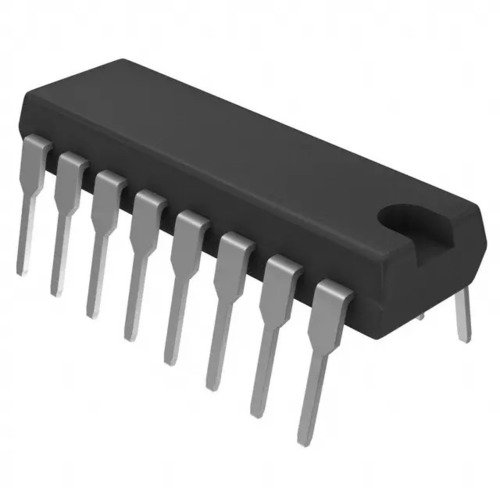
PGA205P
500 INR
Product Details:
- Interface DIP through-hole
- Response Time Slew rate 0.25V/s typ
- Operating Temperature 0C to +70C
- Output Single-ended analog signal
- Power Supply Dual supply, 15V typical
- Input Differential analog signal
- Components Monolithic operational amplifier IC
- Click to View more
X
PGA205P Price And Quantity
- 500 INR
- 10 Piece
- 8 pins
- 0.3 V/µs
- RoHS Compliant
- ±13.4V (with ±15V supply)
- PDIP (Plastic Dual In-Line Package)
- 106 dB typical
- Through Hole
- 1 to 1000 (externally set by resistor)
- 100 µV max
PGA205P Product Specifications
- Approx. 2g
- Dual supply, 15V typical
- 15V
- Standard IC housing
- Black, Grey
- Signal amplification
- Bandwidth up to 800 kHz
- Single-ended analog signal
- 0C to +70C
- Precision programmable instrumentation amplifier
- Slew rate 0.25V/s typ
- DIP through-hole
- 9.9 mm x 7.6 mm x 3.2 mm
- 15V
- DIP-8 package
- Audio, Medical instrumentation, Data acquisition
- Monolithic operational amplifier IC
- Differential analog signal
- Low offset, high CMRR, programmable gain, DIP packing
- 2.8 mA typ quiescent
- DC powered
- Integrated Circuit (IC)
- 8 pins
- 0.3 V/µs
- RoHS Compliant
- ±13.4V (with ±15V supply)
- PDIP (Plastic Dual In-Line Package)
- 106 dB typical
- Through Hole
- 1 to 1000 (externally set by resistor)
- 100 µV max
PGA205P Trade Information
- All India
Product Description
Specification
| Amplifier Type | Instrumentation |
| Mounting Type | Through Hole |
| Voltage Supply Single Dual | 9 V ~ 36 V,+-4.5 V ~ 18 V |
| Voltage Input Offset | 25uV |
| Three db Bandwidth | 1MHz |
| Supplier Device Package | 16-PDIP |
| Slew Rate | 0.7 V/us |
| Part Status | Active |
| Packaging | Tube |
| Package Case | 16-DIP (0.300",7.62mm) |
| Operating Temperature | -40 deg C ~ 85 |
| Number of Circuits | 1 |
| Current Supply | 5.2mA |
| Current Output Channel | 23mA |
| Current Input Bias | 500pA |
| Base Part Number | PGA205 |
High Precision Amplification
The PGA205P is engineered to deliver precise signal amplification, minimizing input offset voltage and maximizing common mode rejection. Its low offset and programmable gain ensure accuracy, making it well-suited for sensitive applications including audio processing and medical device interfaces, where signal integrity is paramount.
Versatile and Flexible Design
With its resistor-programmable gain spanning from 1 to 1000 and broad supply voltage compatibility (15V), the PGA205P adapts effortlessly to varied application demands. Its compact DIP-8 housing and through-hole mounting facilitate straightforward circuit integration for rapid prototyping or volume production.
Robust Performance and Compliance
Operating within 0C to +70C and supporting output swings near rails (13.4V), the PGA205P is reliable in diverse environments. Its RoHS compliance and standard IC housing ensure compatibility with modern manufacturing expectations and environmental requirements.
FAQs of PGA205P:
Q: How is the gain adjusted on the PGA205P instrumentation amplifier?
A: The gain of the PGA205P is set externally by connecting a resistor between specific gain-setting pins. This allows you to adjust the amplification factor from 1 to 1000, providing exceptional versatility for various signal levels.Q: What benefits does the high common mode rejection ratio (CMRR) offer?
A: A typical CMRR of 106 dB ensures that unwanted common-mode signals, such as noise or interference, are effectively rejected. This translates to clearer, more accurate signal amplification in applications like data acquisition and medical instruments.Q: When should the PGA205P be used in an application?
A: Use the PGA205P when precise signal amplification is required, especially in applications where low offset and high gain programmability are critical, such as audio systems, medical devices, and instrumentation requiring differential input and single-ended output.Q: What is the recommended power supply for the PGA205P?
A: The amplifier is designed to operate with a dual power supply, typically 15V DC. This allows the device to achieve a wide output voltage swing and optimal performance.Q: Where can the PGA205P be mounted, and what is its package type?
A: The PGA205P is provided in an 8-pin PDIP (Plastic Dual In-Line Package) and is intended for through-hole mounting, making it suitable for standard PCB designs and prototyping needs.Q: What is the process for integrating the PGA205P into a circuit?
A: Integration involves placing the device on a through-hole PCB, soldering the pins, and connecting appropriate external resistors to set the gain. Ensure power supplies and input/output signal lines match the specified ratings for safe operation.Q: What are the key usage benefits of the PGA205P in signal amplification?
A: The primary benefits include low input offset, excellent noise rejection, high programmability of gain, wide supply voltage and output swing, and straightforward DIP packaging for ease of useideal for high-precision, reliable analog signal processing.Tell us about your requirement

Price:
Quantity
Select Unit
- 50
- 100
- 200
- 250
- 500
- 1000+
Additional detail
Mobile number
Email

Other Products in 'Burr - Brown ICs' category



Contact Details
KK INTERNATIONAL
Mumbai, Maharashtra, India
Mumbai, Maharashtra, India

- Plot No. 305, Rajdeep Apartments, Tara Temple Lane, Near Lamington Road,Mumbai - 400007, Maharashtra, India
- Phone : 08045477473
- Mr Pratik Chouhan (Managing Director)
- Mobile : 08045477473
-
 Send Inquiry
 Send Inquiry
 Send Inquiry
 Send SMS
Quick Inquiry

 |
KK INTERNATIONAL
All Rights Reserved.(Terms of Use) Developed and Managed by Infocom Network Private Limited. |
