


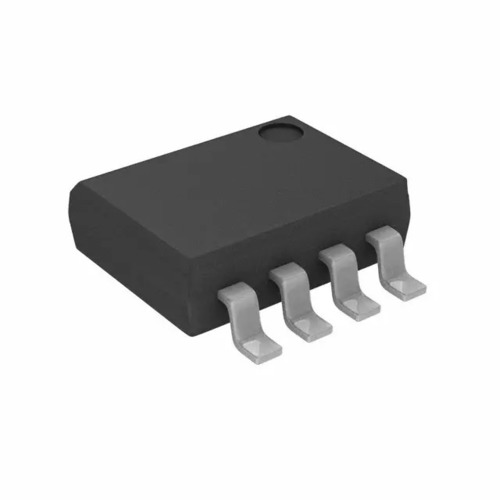
AT45DB161D
50.00 - 200.00 INR
Product Details:
- Input SPI (Serial Peripheral Interface)
- Response Time Fast Page Programming: 1ms typical
- Operating Temperature -40C to +85C
- Interface SPI (Serial Peripheral Interface)
- Power Supply DC
- Power Source External DC
- Usage Serial non-volatile memory storage
- Click to View more
X
AT45DB161D Price And Quantity
- 50.00 - 200.00 INR
- 10 Piece
- 8-SOIC, 16-SOIC, 8-DFN/MLP, 8-UDFN, 8-TSOP
- 8 or 16 pins depending on package
- 528 pages, each 528 or 512 bytes user-configurable
- 2 buffers of 528 bytes each
- Byte/Page Program, Buffer Write, Continuous Array Write
- 20 years (typ.)
- Page (528/512 Bytes), Block (4,096 Bytes), Sector (131,072 Bytes), Chip
- 100,000 program/erase cycles per page (typ.)
- Random Byte/Page
- Yes, via software commands
- Yes
- No hardware ECC
- 25A (typical in standby)
AT45DB161D Product Specifications
- SPI (Serial Peripheral Interface)
- DataFlash memory IC
- 8-SOIC/16-SOIC/8-DFN
- 16 Mbit (2 MByte)
- 2.7V to 3.6V
- 5.0mm x 6.2mm x 1.75mm (8-SOIC typical)
- 2.7V to 3.6V
- Embedded systems, microcontroller memory extension
- Page Program: 15mA (typ), Read: 14mA (max)
- DataFlash Serial Memory IC
- SPI (Serial Peripheral Interface)
- External DC
- DC
- One IC chip
- Flexible page and block erase, dual buffer, low power consumption
- Serial non-volatile memory storage
- ~0.5g (typical for 8/16-SOIC)
- Digital Memory Data
- Up to 66MHz clock rate
- Depends on package, approx. 1.75mm (8-SOIC)
- Black
- Fast Page Programming: 1ms typical
- -40C to +85C
- 8-SOIC, 16-SOIC, 8-DFN/MLP, 8-UDFN, 8-TSOP
- 8 or 16 pins depending on package
- 528 pages, each 528 or 512 bytes user-configurable
- 2 buffers of 528 bytes each
- Byte/Page Program, Buffer Write, Continuous Array Write
- 20 years (typ.)
- Page (528/512 Bytes), Block (4,096 Bytes), Sector (131,072 Bytes), Chip
- 100,000 program/erase cycles per page (typ.)
- Random Byte/Page
- Yes, via software commands
- Yes
- No hardware ECC
- 25A (typical in standby)
AT45DB161D Trade Information
- Cash Against Delivery (CAD), Cash on Delivery (COD), Delivery Point (DP), Cash in Advance (CID), Cheque, Cash Advance (CA)
- 1000 Piece Per Week
- 2 Days
- Yes
- If order is confirmed we will reimburse the sample cost
- All India
Product Description
Specification
| Base Part Number | AT45DB161 |
| Mounting Type | Surface Mount |
| Write Cycle Time Word Page | 6ms |
| Voltage Supply | 2.7 V ~ 3.6 V |
| Technology | Flash |
| Supplier Device Package | 8-SOIC |
| Part Status | Obsolete |
| Packaging | Tube |
| Package Case | 8-SOIC (0.209", 5.30mm Width) |
| Operating Temperature | -40 deg C ~ 85 deg C (TC) |
| Memory Type | Non-Volatile |
| Memory Size | 16Mb (528 Bytes x 4096 pages) |
| Memory Interface | SPI |
| Memory Format | Flash |
| Clock Frequency | 66MHz |
Flexible Configuration and Erase Options
The AT45DB161D features user-configurable page sizes of 528 or 512 bytes, accommodating a wide range of application requirements. It supports versatile erase operations, including page, block (4,096 bytes), sector (131,072 bytes), and entire chip erases, making memory management efficient and adaptable for embedded development.
High Endurance and Reliable Data Retention
Delivering 100,000 program/erase cycles per page and a typical 20-year data retention guarantee, the AT45DB161D ensures long-term reliability for critical data storage, even in challenging industrial environments with operating temperatures ranging from -40C to +85C.
Efficient Operation and Power Saving
With a typical standby current of just 25A and active operation currents suited for page programs (15mA typical) and read (14mA max), the AT45DB161D supports energy-efficient applications. The device is ideal for power-sensitive embedded systems requiring non-volatile memory expansion.
FAQs of AT45DB161D:
Q: How is data written and erased on the AT45DB161D?
A: Data can be programmed in either byte or page mode using the SPI interface. Erasing is flexible and can be done at the page, block, sector, or entire chip level, allowing efficient memory management and use.Q: What benefits does the dual-buffer architecture provide?
A: The two 528-byte buffers enable faster programming and data transfer. While one buffer is being written to the array, the other can prepare the next data stream, supporting seamless operations and minimizing system downtime.Q: When should you enable the write protection feature?
A: Write protection, implemented via software commands, should be used whenever you need to safeguard valuable data from accidental overwrites or corruption, especially in system-critical or secure applications.Q: Where is the AT45DB161D most commonly used?
A: This memory IC is typically used in embedded systems, microcontroller-based devices, and applications where compact form factor, high endurance, and reliable data retention are essential, such as IoT gadgets, industrial controls, and consumer electronics.Q: What is the process for configuring the page size?
A: Page size (528 or 512 bytes) is set via a dedicated command sequence through SPI. This is a one-time programmable feature, so it must be chosen carefully during initial device setup.Q: How does the AT45DB161D handle power consumption?
A: It uses a low standby current (25A typical) and supports efficient active currents for programming and reading, making it ideal for applications requiring low power and long battery life.Q: What are the package and pin options available for AT45DB161D?
A: Available in various packages such as 8-SOIC, 16-SOIC, 8-DFN, 8-UDFN, and 8-TSOP, the AT45DB161D supports both 8 and 16 pin configurations, accommodating different board layouts and space requirements.Tell us about your requirement

Price:
Quantity
Select Unit
- 50
- 100
- 200
- 250
- 500
- 1000+
Additional detail
Mobile number
Email

Other Products in 'Atmel ICS' category


Contact Details
KK INTERNATIONAL
Mumbai, Maharashtra, India
Mumbai, Maharashtra, India

- Plot No. 305, Rajdeep Apartments, Tara Temple Lane, Near Lamington Road,Mumbai - 400007, Maharashtra, India
- Phone : 08045477473
- Mr Pratik Chouhan (Managing Director)
- Mobile : 08045477473
-
 Send Inquiry
 Send Inquiry
 Send Inquiry
 Send SMS
Quick Inquiry

 |
KK INTERNATIONAL
All Rights Reserved.(Terms of Use) Developed and Managed by Infocom Network Private Limited. |
