


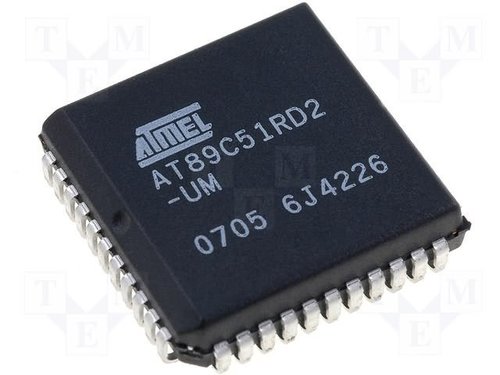
MICROCONTROLLER IC
100 INR/Piece
Product Details:
- Thermal Conductivity Low
- Features Programmable, low power consumption, multiple interfaces
- Interface UART, SPI, I2C, GPIO
- Processor Speed 16 MIPS
- Display Type None (external interface supported)
- Input Digital and analog signals
- Response Time Microseconds
- Click to View more
X
MICROCONTROLLER IC Price And Quantity
- 100 INR/Piece
- 20 Piece
- 3 x 16-bit
- 40
- 2 KB
- 6
- Integrated
- 1 KB
- Crystal Oscillator
- 5919134
- 12V
- Yes
- Yes
- < 120 mW
- Through-Hole
- 8-bit RISC
- Dual In-line Package (DIP-40)
MICROCONTROLLER IC Product Specifications
- Digital and analog signals
- Standard DIP
- Black
- Integrated Circuit (IC)
- None (external interface supported)
- 16 MIPS
- UART, SPI, I2C, GPIO
- Programmable, low power consumption, multiple interfaces
- Embedded system control and interfacing
- Low
- 32 KB flash memory
- 4.5V to 5.5V
- Microcontroller core, I/O pins, timers, memory
- Microcontroller based electronics
- DC
- 2 mm
- GPIO, UART, SPI, I2C
- Microseconds
- 10-bit ADC
- 16 MHz
- 20 mA per I/O pin
- ~5 g
- -40C to +85C
- Supports external sensors
- External DC supply
- 5V
- Automation, robotics, consumer electronics
- 50 mm x 20 mm x 2 mm
- 3 x 16-bit
- 40
- 2 KB
- 6
- Integrated
- 1 KB
- Crystal Oscillator
- 5919134
- 12V
- Yes
- Yes
- < 120 mW
- Through-Hole
- 8-bit RISC
- Dual In-line Package (DIP-40)
MICROCONTROLLER IC Trade Information
- Cash Against Delivery (CAD), Cash in Advance (CID)
- Yes
- All India
Product Description
This MICROCONTROLLER IC is an electronic component that is used to control and manage various tasks in a wide range of applications. It is commonly used in embedded systems, robotics, automation, and various other applications where control and monitoring of devices and systems are required. The purpose of this MICROCONTROLLER IC is to provide a cost-effective and efficient solution for controlling and managing various tasks, making this microcontroller an essential component in modern electronics and technology.
Highly Versatile Interface Capabilities
Equipped with multiple communication protocolsUART, SPI, I2C, and GPIOthis microcontroller seamlessly interfaces with a range of digital and analog peripherals. Its 6 PWM channels, three independent timers, and integrated watchdog support accurate signal manipulation and reliable system monitoring for complex embedded tasks.
Robust Performance with Low Power Consumption
Operating at up to 16 MHz and delivering quick response times in the microsecond range, this microcontroller balances high-speed operation with efficient power usage (less than 120 mW). Its wide operating voltage and temperature ranges add reliability for demanding environments.
Flexible Application in Embedded Systems
This IC is designed for through-hole mounting, suited for prototyping and production. With 32 KB flash memory, 2 KB RAM, and supported programming voltage (12V), it is user-friendly and versatile. Its high ESD protection and RoHS compliance ensure durability, while supporting integration with external sensors expands its usage in various automated systems.
FAQs of MICROCONTROLLER IC:
Q: How can I program this DIP-40 microcontroller?
A: This microcontroller can be programmed through its dedicated programming interface, requiring a 12V programming voltage. Standard programming software compatible with 8-bit RISC architectures should be used, and connections can be made using a compatible development board or through in-system programming headers.Q: What are the primary benefits of using this microcontroller in automation projects?
A: The microcontroller offers multiple timers, PWM channels, integrated ADC, and robust communication interfacesmaking it suitable for precise control and monitoring tasks. Its low power requirements, wide input voltage, and excellent ESD protection enhance reliability in industrial automation environments.Q: When should I use the watchdog timer feature?
A: The integrated watchdog timer is crucial when system reliability is paramount. Use it in applications where unexpected software anomalies might occur, as it helps automatically reset the microcontroller in case of system instability or crashes, preventing lock-ups.Q: Where can I integrate this microcontroller for best results?
A: This microcontroller excels in embedded control systems for robotics, consumer electronics, and automated appliances. Its wide operating temperature and robust feature set make it suitable for both prototyping on development boards and final products deployed in harsh or variable environments.Q: What process is involved in mounting this microcontroller?
A: Mounting is straightforward due to the standard Dual In-line Package (DIP-40) design. It supports through-hole soldering onto PCBs, making it suitable for manual assembly, breadboarding during development stages, or automated production processes.Q: How does the microcontroller handle inputs and outputs?
A: It supports both digital and analog input signals via its GPIO and 10-bit ADC. Outputs can be delivered through general-purpose pins and interfaces such as UART, SPI, and I2Cenabling easy connection to displays, sensors, motors, or communication modules.Q: What advantages does its architecture and memory capacity offer?
A: The 8-bit RISC architecture ensures efficient instruction execution (up to 16 MIPS at 16 MHz). With 32 KB flash, 2 KB RAM, and 1 KB EEPROM, it can handle complex programs and data storage operations for sophisticated embedded applications.Tell us about your requirement

Price:
Quantity
Select Unit
- 50
- 100
- 200
- 250
- 500
- 1000+
Additional detail
Mobile number
Email

Other Products in 'Electronic Components' category



Contact Details
KK INTERNATIONAL
Mumbai, Maharashtra, India
Mumbai, Maharashtra, India

- Plot No. 305, Rajdeep Apartments, Tara Temple Lane, Near Lamington Road,Mumbai - 400007, Maharashtra, India
- Phone : 08045477473
- Mr Pratik Chouhan (Managing Director)
- Mobile : 08045477473
-
 Send Inquiry
 Send Inquiry
 Send Inquiry
 Send SMS
Quick Inquiry

 |
KK INTERNATIONAL
All Rights Reserved.(Terms of Use) Developed and Managed by Infocom Network Private Limited. |
