


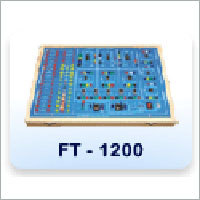
Operational Amplifiers
100 INR
Product Details:
- Output Single-ended, Low Impedance
- Features Low noise, high gain, versatile applications
- Operating Temperature 0C to 70C
- Response Time 1 s
- Power Source External DC
- Resolution Analog
- Interface Pin-based IC interface
- Click to View more
X
Operational Amplifiers Price And Quantity
- 10 Piece
- 100 INR
- RoHS Compliant
- Not isolated
- (V+ - 1.5 V) to (V- + 1.5 V)
- 70 dB (Typical)
- 2 mV (Typical)
- Tube / Tape & Reel
- DIP-8, SOIC-8
- 0.5 V/µs
- 20 nA (Typical)
- Tin-plated
- Through Hole / Surface Mount
- 1-4 (depending on model)
Operational Amplifiers Product Specifications
- 1 s
- Amplification of electrical signals
- Typical, plastic package
- 2 mA (Typical quiescent current)
- 15 VDC
- Standard DIP-8 or SOIC-8 Package
- Pin-based IC interface
- 3V to 32V
- Low noise, high gain, versatile applications
- Single-ended, Low Impedance
- 0C to 70C
- 9.8mm x 7.6mm x 5mm
- Audio, instrumentation, signal conditioning
- Analog
- Black
- Differential, High Impedance
- Approx. 5 mm
- 1 MHz (Gain Bandwidth Product)
- Dual (+/-) 15V or single 5V-30V
- Integrated Circuit (IC)
- Analog signal processing, filtering, amplification
- ~1.5g
- External DC
- Operational Amplifier IC
- RoHS Compliant
- Not isolated
- (V+ - 1.5 V) to (V- + 1.5 V)
- 70 dB (Typical)
- 2 mV (Typical)
- Tube / Tape & Reel
- DIP-8, SOIC-8
- 0.5 V/µs
- 20 nA (Typical)
- Tin-plated
- Through Hole / Surface Mount
- 1-4 (depending on model)
Operational Amplifiers Trade Information
- All India
Product Description
We have scaled to the newer heights of success by supplying our clients Operational Amplifiers. These amplifiers are used in a range of circuits. They are generally used to amplify weak electrical current in a circuit. These amplifiers have all the properties required for nearly ideal DC amplification and are therefore used extensively in signal conditioning, filtering or to perform mathematical operations such as add, subtract, integration and differentiation. Operational Amplifiers are designed to be used with external feedback components such as resistors and capacitors between its output and input terminals.
Features:
- High-gain electronic voltage amplifier
- Infinite bandwidth
- Single ended output
Precision Analog Signal Amplification
Operational amplifiers deliver high accuracy, low noise, and impressive common-mode rejectionideal for a broad range of analog signal applications. Their robust design and wide supply voltage support ensure performance consistency in demanding environments, from audio circuits to advanced instrumentation.
Versatile Packaging and Mounting Options
Choose from standard DIP-8 or SOIC-8 packages to suit your assembly process, whether you are using through-hole or surface mount technology. Tightly controlled mechanical dimensions and lightweight design make them suitable for compact and large-scale circuits alike.
Reliable Performance in Indian Markets
As a trusted distributor, supplier, and manufacturer in India, we guarantee authentic, high-quality operational amplifiers tailored to industry needs. RoHS compliance, tin-plated lead finish, and robust build quality ensure long-term service across a spectrum of applications.
FAQs of Operational Amplifiers:
Q: How do I select the right number of channels for my application?
A: Choose the number of channels based on your applications needs; single-channel Op-Amps suit simple amplification tasks, while devices with up to four channels are ideal for multi-stage amplification or differential signal processing.Q: What benefits do the low offset voltage and input bias current offer?
A: A typical offset voltage of 2 mV and low input bias current (20 nA) minimize signal distortion and drift, enhancing measurement accuracy and audio fidelity, especially in sensitive analog environments.Q: When should I use a dual supply versus a single supply configuration?
A: A dual (+/-15V) supply is recommended for applications demanding symmetrical swing around ground, such as audio or instrumentation, while a single supply (5V30V) suits battery-powered or cost-sensitive designs.Q: Where can I use these operational amplifiers effectively?
A: They are suitable for audio amplification, signal conditioning, and instrumentation circuits in both industrial and commercial environments, meeting diverse requirements in the Indian market.Q: What is the typical process for mounting these Op-Amps?
A: Depending on your board design, use through-hole soldering for DIP-8 or surface mounting (SMT) for SOIC-8. Both package types are available in tube or tape & reel packaging for production convenience.Q: How does the common-mode rejection ratio (CMRR) benefit my circuit?
A: A typical 70 dB CMRR ensures unwanted noise and interference on input lines are effectively rejected, leading to cleaner signal amplification and improved overall system performance.Q: What makes these Op-Amps a good choice for signal processing in India?
A: These Op-Amps are RoHS compliant, come from reliable suppliers and manufacturers, offer robust performance under standard temperatures, and are designed for ease of integration, making them an excellent fit for Indian industry requirements.Tell us about your requirement

Price:
Quantity
Select Unit
- 50
- 100
- 200
- 250
- 500
- 1000+
Additional detail
Mobile number
Email

Other Products in 'Electronic Components' category



Contact Details
KK INTERNATIONAL
Mumbai, Maharashtra, India
Mumbai, Maharashtra, India

- Plot No. 305, Rajdeep Apartments, Tara Temple Lane, Near Lamington Road,Mumbai - 400007, Maharashtra, India
- Phone : 08045477473
- Mr Pratik Chouhan (Managing Director)
- Mobile : 08045477473
-
 Send Inquiry
 Send Inquiry
 Send Inquiry
 Send SMS
Quick Inquiry

 |
KK INTERNATIONAL
All Rights Reserved.(Terms of Use) Developed and Managed by Infocom Network Private Limited. |
